





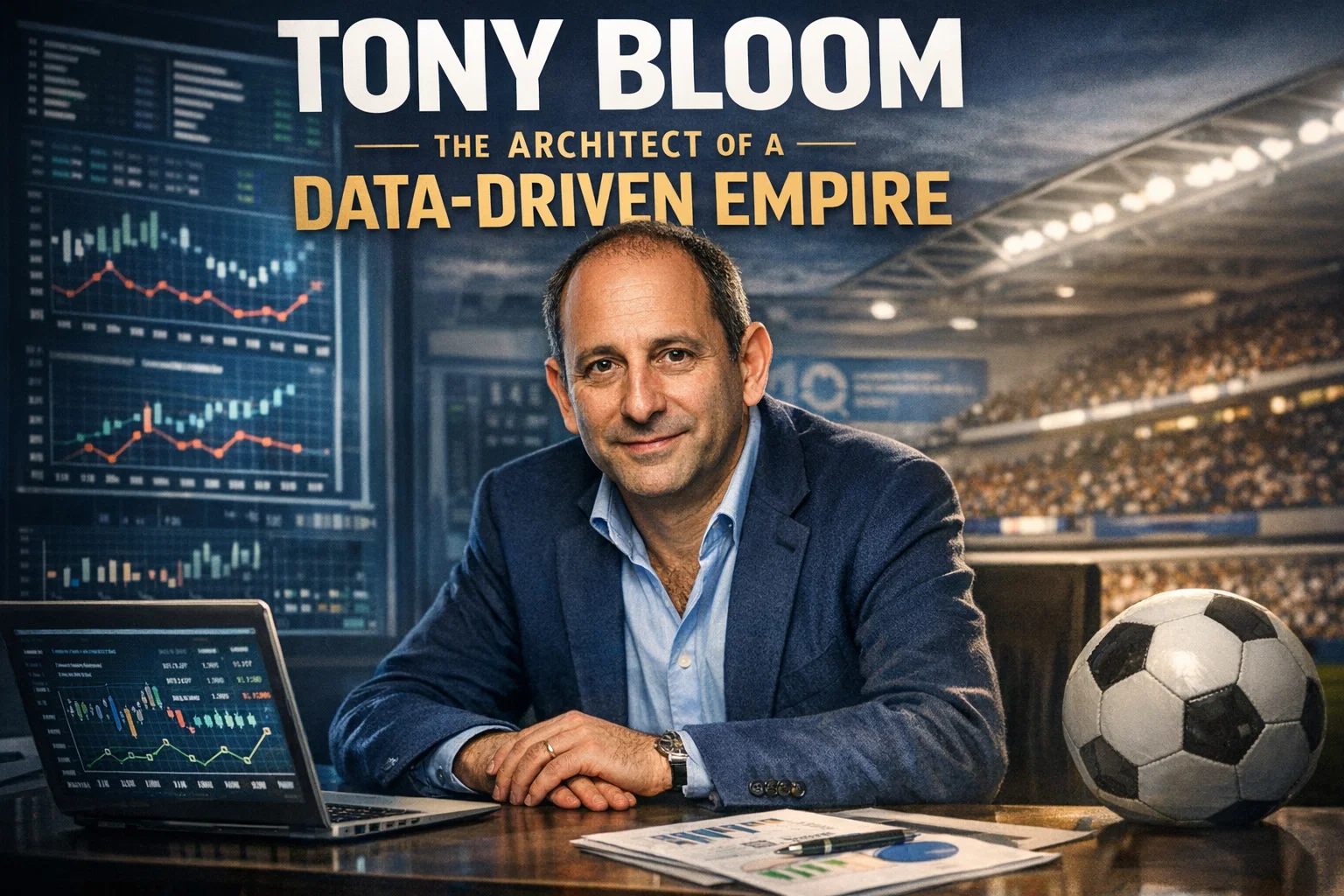
Tony Bloom: The Architect of a Data-Driven Empire
In the intersecting worlds of high-stakes gambling, professional football, and quantitative investment, few figures are as consequential yet deliberately low-profile as Tony Bloom. Known as “The Lizard” for his cool, analytical prowess, Bloom has constructed a unique and immensely successful empire built on a singular foundation: the power of data. His story is not one of flamboyant risk-taking, but of disciplined intelligence, applied across disparate fields with stunning results
From the poker tables of Monte Carlo to the dugouts of the Premier League, Tony Bloom represents a new archetype of modern mogul—one who sees the world through probabilities and leverages that insight to gain a decisive edge. This article unravels the multifaceted career of a man who turned a mathematical mind into sporting and financial glory.
The Making of a Mathematical Mind
Long before he was a football chairman, Tony Bloom was a prodigy in calculating odds. Born into a family of Brighton supporters and professional gamblers, he was immersed in a world where statistical likelihood trumped gut feeling from a young age. He studied mathematics at the University of Manchester, but his real education was happening concurrently at the betting shop and the poker table. This dual training—formal academic rigor and applied, high-pressure gambling—forged his unique approach. He learned to divorce emotion from decision-making, a trait that would become his trademark.
Bloom’s early career was a direct application of this mindset. He wasn’t a gambler in the traditional sense; he was a professional arbitrageur, exploiting tiny pricing inefficiencies across global betting markets. This required immense capital, nerve, and computational skill. He later transitioned to poker, where his mathematical edge and psychological discipline made him a world-class tournament player, with major cashes at the World Series of Poker and the World Poker Tour. This period was crucial, proving that his data-centric model could deliver monumental success in fiercely competitive environments.
Founding Starlizard: The Analytics Engine
The true crystallization of Bloom’s philosophy came with the founding of Starlizard. Often mischaracterized as a mere betting syndicate, Starlizard is better understood as a proprietary trading firm for sports. At its core, it is a vast data analytics and research organization. The company employs hundreds of analysts, statisticians, and scouts who collect and process millions of data points on football matches worldwide. Their goal isn’t to bet on gut instinct but to build models that predict outcomes more accurately than the bookmakers’ odds.
This operation is shrouded in secrecy, but its influence is profound. Starlizard’s insights provide a continuous, massive revenue stream that funds Bloom’s other ventures. More importantly, it serves as the intellectual engine for his football operations. The line between Starlizard’s analytical work and the recruitment strategy at Brighton & Hove Albion is intentionally blurred, creating a powerful feedback loop where data informs sporting decisions and on-pitch results refine the analytical models. It is a self-perpetuating cycle of informed advantage.
Transforming Brighton & Hove Albion
When Tony Bloom took majority ownership of his boyhood club, Brighton & Hove Albion, in 2009, they were a League One team with an outdated stadium and an uncertain future. His project was not a petrostate-funded fantasy but a meticulously planned ascent. He financed the state-of-the-art American Express Stadium, a £93 million bet that stabilized the club’s foundations. But the real transformation was philosophical. Bloom installed a structure built on the same principles as his other enterprises: long-term planning, data intelligence, and emotional discipline.
The club’s recruitment, led by the renowned Dan Ashworth, became a benchmark for the industry. Brighton’s “secret” was no secret at all—it was superior analytics. They identified undervalued players in overlooked markets, focusing on specific psychological and technical profiles that fit their playing model. This data-driven approach, funded by Bloom’s wealth and guided by Starlizard-adjacent insight, took Brighton from perennial Championship hopefuls to established Premier League innovators and European competitors. As football journalist Rory Smith observed, “Bloom didn’t just buy a club; he built a system.”
The Poker Face of Business and Sport
A common misconception is that Tony Bloom’s success in gambling translates to reckless risk-taking in business. The opposite is true. Professional poker, at his level, is about minimizing risk through information. Every decision is a calculated move based on known probabilities, pot odds, and player psychology. Bloom has imported this “poker face” into his entire portfolio. Whether negotiating a player transfer, investing in a startup, or deciding a stadium expansion, the process is analytical, not emotional.
This approach creates a remarkable consistency across his ventures. The high-pressure, probabilistic environment of a poker tournament directly mirrors the high-stakes, financially driven world of football recruitment and player trading. In both, patience is a weapon, and capital is deployed not when hope is high, but when the numbers are favorable. This disciplined detachment allows Bloom to make tough, counter-intuitive decisions—like selling key players for substantial profits—that weaker, more sentiment-driven owners might avoid, thereby ensuring the long-term sustainability of his projects.
A Comparative Look at Bloom’s Dual Ventures
While seemingly separate, Tony Bloom’s football club and his analytics firm are two sides of the same coin. Both are laboratories for his data-driven philosophy, each informing and strengthening the other. The table below illustrates the powerful synergy between these core pillars of his empire:
| Aspect | Starlizard (The Analytics Engine) | Brighton & Hove Albion (The Sporting Application) | The Synergistic Link |
| Primary Goal | Generate profit by beating the betting market’s odds. | Achieve sporting success & financial sustainability. | Profits from Starlizard fund club development. Sporting data refines analytical models. |
| Core Currency | Data, probabilities, algorithmic models. | Players, points, sporting performance. | Player performance data feeds Starlizard’s databases. Starlizard’s analysis identifies undervalued player profiles. |
| Key Activity | Collecting and analyzing global football data. | Scouting, recruiting, and developing football talent. | Shared intelligence on players, teams, and tactical trends across both organizations. |
| Risk Profile | Financial risk managed through statistical arbitrage. | Sporting & financial risk managed through prudent strategy. | The financial safety net from Starlizard allows for calculated sporting risks at Brighton. |
| Output/Product | Proprietary betting advice & market intelligence. | A competitive football team and valuable player assets. | A sustainable ecosystem where intelligence begets profit, which begets further sporting success. |
The Philanthropic and Private Persona
Despite his immense influence, Tony Bloom guards his privacy fiercely. He gives few interviews and avoids the spotlight that often follows Premier League owners. This discretion extends to his philanthropy, which is significant but quietly conducted. Through the Bloom Foundation, he and his family have donated millions to charitable causes, with a particular focus on community projects in Brighton, mental health charities, and initiatives supporting children and families. This giving reflects a deep connection to his city, separate from his football investment.
This private nature is strategic, allowing his work to speak for itself. In an era of celebrity owners, Bloom is a silent operator. He is not the face of Brighton & Hove Albion; the manager and players are. He is not a pundit for the betting industry; Starlizard’s results are. This dichotomy—between his vast, data-powered public footprint and his intensely private personal life—only adds to the enigmatic and respected aura that surrounds him. He is a decision-maker, not a figurehead.
Legacy and Future Influence
Tony Bloom’s legacy is already secure as the man who mathematically engineered a small club’s ascent into England’s top tier and built a hidden financial giant in Starlizard. However, his broader impact may be his validation of a hyper-rational, data-centric model in industries traditionally ruled by passion and instinct. He has proven that in football, the “moneyball” approach, when executed with sufficient scale and sophistication, can compete with and outmaneuver vastly richer rivals.
How Old Is Miley Cyrus? Tracing the Journey of a Pop Culture Icon
Looking forward, Bloom’s influence is set to grow. The Brighton model is now studied and emulated by clubs worldwide. The methodologies pioneered at Starlizard are at the forefront of the sports analytics revolution. As artificial intelligence and machine learning become more pervasive, Bloom’s early and total commitment to data positions his ventures at the vanguard. His story suggests that the future of competitive advantage, in sport and beyond, belongs not to those with the biggest wallets alone, but to those with the smartest algorithms and the discipline to follow them.
Conclusion
Tony Bloom is a definitive figure of 21st-century success. He has masterfully demonstrated how a core intellectual framework—rooted in mathematics, probability, and emotional discipline—can be applied across different domains to build enduring value. He transformed his childhood club through patience and intelligence, not just capital. He built a shadowy, immensely profitable enterprise that turns sports into a science. In doing so, Bloom redefined what it means to be an owner, an investor, and a strategist. His career is a powerful testament to the idea that in a world flooded with information, the greatest edge is the ability to understand it.
Frequently Asked Questions (FAQ)
How did Tony Bloom make his money?
Tony Bloom made his initial fortune through professional gambling and sports arbitrage, using mathematical models to exploit inefficiencies in betting markets. He solidified his wealth as a successful high-stakes poker player and, most significantly, as the founder and owner of Starlizard, a hugely successful betting syndicate and sports analytics company.
What is Tony Bloom’s net worth?
While exact figures are private, Tony Bloom’s net worth is estimated to be in the range of £1-1.5 billion. This wealth stems primarily from the success of Starlizard, his prudent investment portfolio, and the skyrocketing valuation of Brighton & Hove Albion, which he owns outright.
How is Starlizard connected to Brighton & Hove Albion?
Tony Bloom owns both Starlizard and Brighton. While legally separate, they are strategically linked. Starlizard’s profits help fund the club, and its vast football data analytics likely inform Brighton’s player recruitment and tactical analysis, creating a unique competitive advantage for the Seagulls.
Why is Tony Bloom called “The Lizard”?
The nickname “The Lizard” reflects Tony Bloom’s renowned cool, calm, and analytical demeanor at the poker table and in business. It suggests an unemotional, calculated, and reptilian-like focus on the odds, a persona that has become synonymous with his approach to risk and decision-making.
Does Tony Bloom still play poker?
While he is not a full-time professional player, Tony Bloom still occasionally plays in high-profile poker tournaments. He maintains a world-class skill level, and his sporadic appearances, such as at the World Series of Poker in Las Vegas, are notable events in the poker community.