





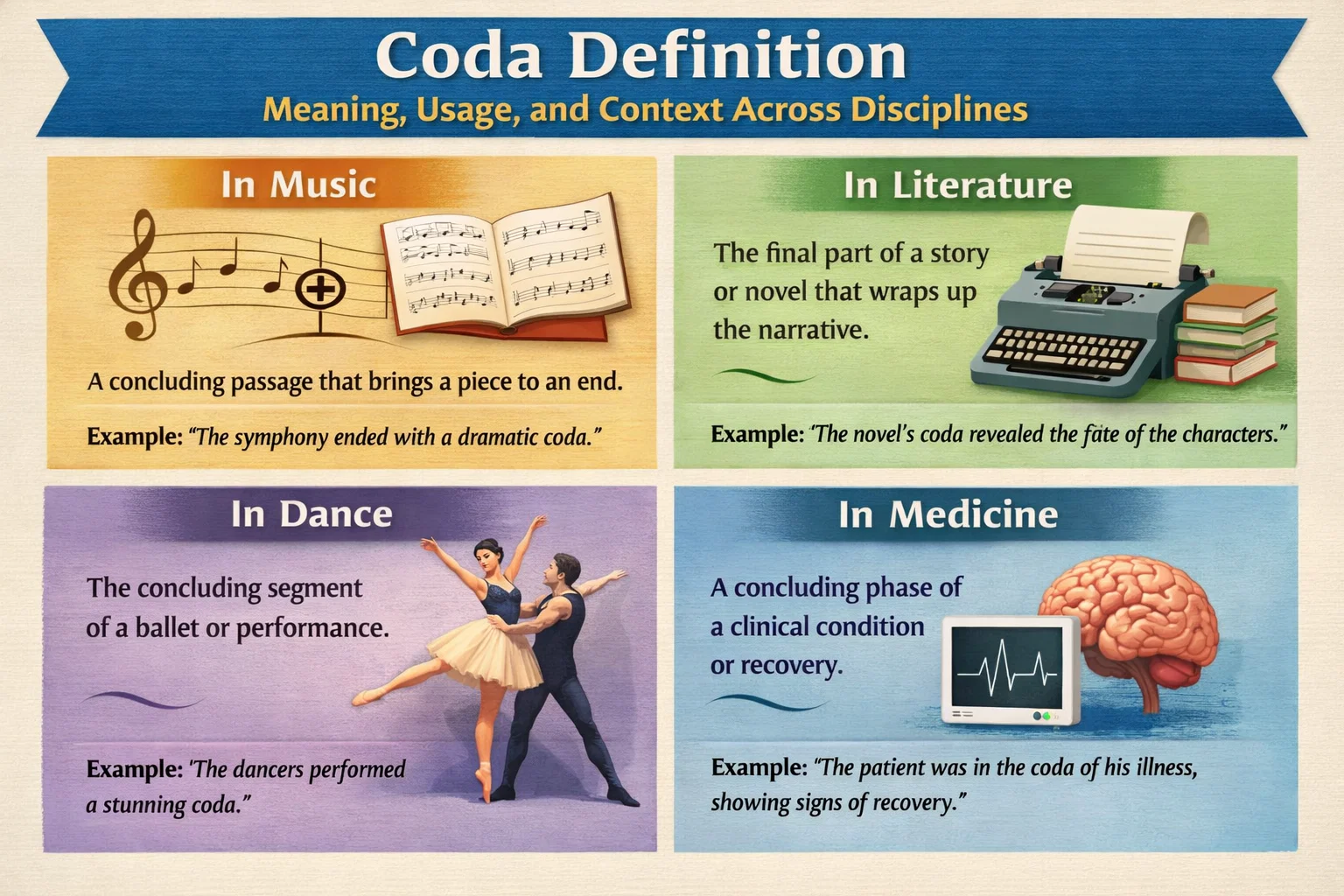
Coda Definition: Meaning, Usage, and Context Across Disciplines
Understanding the coda definition unlocks clarity across multiple fields, from music and literature to business communication and legal language. Though the word may appear specialized, its meaning is surprisingly versatile and deeply practical in everyday analysis and creative work.
This guide explores the coda definition with depth, precision, and real-world relevance. By the end, you’ll understand not just what a coda is, but why it matters, how it’s used correctly, and how its meaning shifts across contexts without losing its core purpose.
What the Term Coda Means at Its Core
At its foundation, the coda definition refers to a concluding section that brings a work to a deliberate and meaningful close. The term originates from the Latin word cauda, meaning “tail,” which perfectly captures its function as the ending segment that follows the main body.
Unlike a simple ending, a coda adds resolution, emphasis, or reflection. It exists to reinforce meaning, tie together ideas, or leave a lasting impression, rather than merely stopping the work.
Coda Definition in Music Theory
In music, the coda definition describes a passage that comes after the final structural section of a composition. It often extends the ending, giving composers space to reinforce themes or provide a sense of finality beyond the expected close.
A musical coda can be brief or expansive, subtle or dramatic. What matters is its role in signaling completion while enhancing emotional impact, not simply repeating what has already been heard.
How Coda Is Used in Literature and Storytelling
Within literature, the coda definition refers to a concluding segment that reflects on the narrative after the main plot has resolved. Authors use codas to show long-term consequences, emotional aftereffects, or thematic closure.
This literary device is especially common in novels, memoirs, and essays where reflection matters as much as resolution. A well-crafted coda often deepens meaning rather than summarizing events.
Coda Definition in Film and Visual Media
In film and television, the coda definition applies to scenes or sequences that appear after the central conflict concludes. These moments offer viewers emotional grounding, insight into characters’ futures, or symbolic closure.
Rather than functioning as traditional endings, visual codas often feel reflective or quietly powerful. They allow the story to linger, reinforcing tone and message without reopening the narrative.
Linguistic and Semantic Meaning of Coda
From a linguistic perspective, the coda definition can describe the final consonant or sound in a syllable, following the vowel nucleus. This usage is common in phonetics and language studies.
Here, a coda shapes pronunciation, rhythm, and meaning in spoken language. Though technical, this interpretation still aligns with the broader idea of something that completes or finishes a structure.
Coda in Business, Strategy, and Communication
In professional communication, the coda definition often applies metaphorically to closing statements, final slides, or concluding remarks. These elements reinforce key messages and guide audience takeaway.
A strong business coda doesn’t introduce new ideas. Instead, it clarifies intent, reinforces value, and ensures the message lands with confidence and coherence.
Legal and Formal Usage of Coda
In legal and formal documents, the coda definition refers to an ending clause or section that clarifies implications, limitations, or final conditions. This usage emphasizes precision and closure.
Legal codas are carefully worded to avoid ambiguity. They ensure that the document’s intent remains clear even after the main provisions have been stated.
How Coda Differs From Similar Terms
The coda definition is often confused with terms like conclusion, epilogue, or appendix. While related, a coda is distinct in purpose and tone.
A conclusion summarizes, an epilogue extends the story, and an appendix adds reference material. A coda, by contrast, exists to emotionally or conceptually complete the work.
Comparison of Coda Usage Across Disciplines
The table below highlights how the coda definition adapts across fields while retaining its core meaning.
| Field | Purpose of a Coda | Typical Characteristics |
|---|---|---|
| Music | Extend and resolve the composition | Thematic reinforcement, final cadence |
| Literature | Reflect after narrative resolution | Insightful, emotional, thematic |
| Film | Offer symbolic or emotional closure | Quiet scenes, future hints |
| Linguistics | Complete syllable structure | Final consonant sounds |
| Business | Reinforce key message | Concise, memorable summary |
| Law | Clarify final implications | Precise, limiting language |
Despite contextual differences, each use reflects completion with intention rather than abrupt ending.
Why the Coda Definition Matters More Than You Think
Understanding the coda definition improves how we interpret meaning and structure. Recognizing a coda helps readers, listeners, and viewers appreciate the deliberate choices creators make at the end of a work.
As composer Leonard Bernstein once noted, “The ending must feel earned, not accidental.” A coda exists to earn that ending, providing purpose and resonance.
Common Misconceptions About Codas
A frequent misconception is that a coda is optional or decorative. In reality, many works rely on their coda to achieve emotional or conceptual completeness.
Another misunderstanding is that codas repeat content. While they may echo themes, codas reinterpret rather than duplicate, offering perspective rather than redundancy.
Practical Examples of Codas in Everyday Life
Everyday communication often includes informal codas. A reflective sentence at the end of a presentation or a closing thought in an email functions as a practical coda.
These moments guide interpretation and memory. Even outside formal disciplines, the instinct to conclude thoughtfully mirrors the classic coda definition.
Conclusion: The End That Makes Meaning Last
The coda definition represents more than an ending. It is a purposeful conclusion designed to reinforce, reflect, and resonate. Across music, literature, language, and professional communication, a coda ensures that what comes last truly matters.
By understanding how codas function, you gain deeper insight into structure, intention, and meaning. Whether you’re analyzing art or crafting your own work, mastering the coda elevates how stories and ideas end.
Frequently Asked Questions About Coda Definition
What is the simplest coda definition?
The coda definition describes a concluding section added to bring clarity, emphasis, or emotional closure after the main content ends.
Is a coda the same as a conclusion?
No. While related, the coda definition emphasizes reflection or reinforcement rather than summary or final argument.
How is coda used in music?
In music, the coda definition refers to an ending passage that extends or resolves a composition beyond its formal structure.
Can a coda appear in non-creative writing?
Yes. The coda definition applies to business, legal, and academic contexts where a thoughtful ending strengthens understanding.
Why do authors and composers use codas?
They use codas to ensure the work feels complete, intentional, and emotionally satisfying, fulfilling the core purpose of the coda definition.